
Friday, 7 March 2014

Thursday, 6 March 2014
Educational Uses and Impacts of Arts
1. Academic
--- http://oecdeducationtoday.blogspot.sg/2013/06/arts-education-in-innovation-driven.html
Arts education in innovation-driven societies
by Stéphan Vincent-Lancrin, Senior Analyst and Project Leader, Directorate for Education and Skill, and
Ellen Winner, Professor and Chair of Psychology, Boston College
Ellen Winner, Professor and Chair of Psychology, Boston College
 There is growing consensus that today’s economies require people who can contribute and adapt to innovation. In addition to strong technical skills, many international task forces on the future requirements of our societies have identified skills such as creativity, critical thinking, problem solving, communication and collaboration as critical. Some even see the rise of a “creative class” as the driver of growth, and subject to a growing international competition for talent.
In this context, education systems have to equip students with the skills required for innovation societies, and some countries take this agenda very seriously.
Artists are role models for innovation in our societies, along with scientists and entrepreneurs, and thus it is not surprising that many see arts education as a means of developing skills critical for innovation. According to Arne Duncan, the US Secretary of Education, “education in the arts is more important than ever. In the global economy, creativity is essential. Today’s workers need more than just skills and knowledge to be productive and innovative participants in the workforce. […] To succeed today and in the future, America’s children will need to be inventive, resourceful, and imaginative. The best way to foster that creativity is through arts education”.
In a new OECD report, Art for Art’s Sake? The Impact of Arts Education, the extent to which arts education fosters skills such as critical and creative thinking, motivation, self-confidence, and the ability to communicate and cooperate effectively is assessed. The book also examines whether arts education has an impact on learning non-arts disciplines: reading, mathematics and science.
This kind of exercise typically reveals the scope of our ignorance, and indeed currently many intuitively plausible assumptions are not backed by any empirical evidence. However, a few interesting and robust findings emerged that deserve more attention from parents, teachers and policy makers.
Acquiring foundational skills, notably reading, writing and arithmetics, is a major objective for many countries. Over and over, the PISA study finds that too many 15-year olds have only a basic proficiency in text understanding.
Strong evidence shows that theatre education in the form of enacting stories in the elementary level classroom (classroom drama) strengthens verbal skills (reading, writing, text understanding, etc.). Unfortunately, this does not seem to be a prevalent school practice in many schools.
Music education also has a clear causal impact on verbal skills, probably via its facilitation of auditory skills: music training improves phonological skills, the ability to hear speech in a noisy environment, and there is preliminary evidence that it might facilitate foreign language learning.
What about creativity? And social and behavioural skills? Here we have much less evidence. There are a few studies linking enhanced creativity with theatre and dance education, but their limited number as well as their correlational designs make it impossible to draw causal conclusions. There is also no more than tentative evidence regarding the impact of arts education on behavioural and social skills such as self-confidence, self-concept, motivation, communication and cooperation, empathy, perspective taking and the ability to regulate one’s emotions. Initial evidence concerned with education in dramatic art appears the most promising, with a few studies revealing that drama classes enhance empathy, perspective taking, and emotion regulation – plausible findings given the nature of such education.
Don’t misread these findings. The lack of evidence does not imply a lack of impact. We find very plausible the assumption that different forms of arts education have an impact on creativity, critical thinking and attitudes. For example, Studio Thinking 2 shows that visual arts teachers at their best promote reflection, meta-cognition and other creative habits of mind. They do so by teaching students to evaluate their own works and those of their peers, and asking students to talk about their working process. Research is now called for to test whether students in arts classes actually develop these habits of mind. Other disciplines could learn from arts education how to nurture innovation-friendly habits of mind.
The impact of arts education on non-arts skills and on innovation in the labour market should not be the primary justification for arts education in today’s school curricula. Students who gain mastery in an art form may discover their future career or a lifetime passion. For all children, the arts allow for a different way of understanding than, let us say, the sciences. Arts education allows students to express themselves freely and to discover, explore and experiment. They also give them a safe place to introspect and find personal meaning. In this respect, the arts are important in their own rights for education.
Nevertheless, Art for Art’s Sake? shows that one way to foster skills for innovation societies may well be through the arts, as Arne Duncan put it.
- Effectiveness and more examples http://howthebrainlearns.wordpress.com/2012/03/19/the-impact-of-the-arts/ http://www.arts-impact.org/
- Importance of Arts in Minnesota http://www.arts.state.mn.us/about/facts.htm
2. Moral
- Teaching virtues through fairy tales (Children/students) http://catholiceducation.org/articles/arts/al0134.html
- Art teaching morals, diversity and respect in class (Children/students) http://sitemaker.umich.edu/356.burba/art_teaches_lessons_beyond_creativity_and_theory
- Movies can teach values http://www.todaysengineer.org/2011/jan/worldbytes.asp
- Three-Character Classic http://www.yellowbridge.com/onlinelit/sanzijing.php
Thinking Question
- Does art promote values and morals or does the creation of art overlook morals and values? http://www.open.edu/openlearn/history-the-arts/culture/philosophy/art-censorship-and-morality
Wednesday, 5 March 2014
Essay outline: "Art has little practical value in today's society." What is your view?
"Art has little practical value in today's society." What is your view?
Definition:
Art - Expression or application of human creative skill and imagination. Appreciated primarily for their beauty or emotional power
Practical value - Value of, involving, or concerned with experience or actual use; not theoretical
Today's society - Nowadays, recently, near future
Stand: I disagree that art has little practical value in today's society.
TS 1: Arts enhances education especially in our advanced society where new generation of students are technologically-inclined.
Examples:
- Use of music/movie to learn Chinese as compared to relying on Textbooks
- Visual arts to enhance learning experience (e.g In Singapore now, most schools adopt the Learning Management System also known as LMS to upload videos to help the students understand certain concepts)
TS 2: Art have real world physical application in today's society. What we are studying today are actually written by historians, poets and writers who captured the essences of nature and relationships which leads to our growing understanding of the human relationship and condition.
Examples:
- In today's society, we emphasized a lot of the interaction between different groups of people due to globalisation. People from all over the countries are able to interact easily with the advancement in technology. With arts, we are able to better understand the relationship between different groups of people as seen from the study of history. Hence, with arts, we are more able to apply the skills of interacting and understanding while we meet other people from different backgrounds, minimizing the likely conflict in the future due to miscommunication.
TS 3: In today's society, art is definitely practical because art can foster the kind of innovation that the economy could ultimately benefit from.
-Workers with arts-related skills are critical to the industries of the new economy: software development and web design; advertising firms; automobile design companies; architectural and engineering firms; and other fields seeking employees with high-level communication, computer, and creative problem-solving abilities.
-Support of the arts is a workforce issue for companies—the arts develop the kind of thinker and manager that businesses must have more of if they are to remain competitive in the global marketplace.
-For example, a third of all Fortune 500 CEOs have liberal arts degrees. Leslie Moonves, who leads CBS, has a degree in Spanish from Bucknell University, and Howard Schultz, Starbucks' CEO, majored in communications at Northern Michigan.
COUNTER TS 4: However, some have argued that art is just a hobby or just for entertainment. In addition there is the perspective of art as being the pastime of the elite. What people seem to value now are pursuits that have the most economic and commercial value and not art.
Example:
- Sticker lady incident in Singapore (Show that most people find art impractical and unlikely to support creativity through art, to them, art is just a form of expression with little value)
- In today's society, most do not emphasize on arts. Instead, they emphasize on science and technology instead to move their economy forward as they view art as having little practical value and would not contribute much to economic growth and advancement.
Definition:
Art - Expression or application of human creative skill and imagination. Appreciated primarily for their beauty or emotional power
Practical value - Value of, involving, or concerned with experience or actual use; not theoretical
Today's society - Nowadays, recently, near future
Stand: I disagree that art has little practical value in today's society.
TS 1: Arts enhances education especially in our advanced society where new generation of students are technologically-inclined.
Examples:
- Use of music/movie to learn Chinese as compared to relying on Textbooks
- Visual arts to enhance learning experience (e.g In Singapore now, most schools adopt the Learning Management System also known as LMS to upload videos to help the students understand certain concepts)
TS 2: Art have real world physical application in today's society. What we are studying today are actually written by historians, poets and writers who captured the essences of nature and relationships which leads to our growing understanding of the human relationship and condition.
Examples:
- In today's society, we emphasized a lot of the interaction between different groups of people due to globalisation. People from all over the countries are able to interact easily with the advancement in technology. With arts, we are able to better understand the relationship between different groups of people as seen from the study of history. Hence, with arts, we are more able to apply the skills of interacting and understanding while we meet other people from different backgrounds, minimizing the likely conflict in the future due to miscommunication.
TS 3: In today's society, art is definitely practical because art can foster the kind of innovation that the economy could ultimately benefit from.
-Workers with arts-related skills are critical to the industries of the new economy: software development and web design; advertising firms; automobile design companies; architectural and engineering firms; and other fields seeking employees with high-level communication, computer, and creative problem-solving abilities.
-Support of the arts is a workforce issue for companies—the arts develop the kind of thinker and manager that businesses must have more of if they are to remain competitive in the global marketplace.
-For example, a third of all Fortune 500 CEOs have liberal arts degrees. Leslie Moonves, who leads CBS, has a degree in Spanish from Bucknell University, and Howard Schultz, Starbucks' CEO, majored in communications at Northern Michigan.
COUNTER TS 4: However, some have argued that art is just a hobby or just for entertainment. In addition there is the perspective of art as being the pastime of the elite. What people seem to value now are pursuits that have the most economic and commercial value and not art.
Example:
- Sticker lady incident in Singapore (Show that most people find art impractical and unlikely to support creativity through art, to them, art is just a form of expression with little value)
- In today's society, most do not emphasize on arts. Instead, they emphasize on science and technology instead to move their economy forward as they view art as having little practical value and would not contribute much to economic growth and advancement.
Essay Outline : “Arts does complement science” How true is this?
“Arts does complement science.” How true is this?
Stand: The statement is untrue to a large extent.
Keywords: Arts, Science, Complement
Arts is the various branches of creative activity, such as painting, music, literature, and dance.
Science is the intellectual and practical activity encompassing the systematic study of the structure and behaviour of the physical and natural world through observation and experiment.
Complement is a thing that contributes extra features to something else in such a way as to improve or emphasize its quality.
TS1: Art complements Medical science.
While medical science is able to come out with medical solutions to many of the disease today, it is inevitable that there are side-effects experienced by the users of medical science. While arts might not be able to provide an unparalleled solutions to these diseases or problems, arts have been proven to alleviate the side-effects which Medical science creates.
E.g. Cancer patients often suffer from side-effects which could include pain and agony. Music therapy have been scientifically proven to alleviate this pain and agony. It allows the patient to cope with the pain that they feel during their medical treatment and boost their positive emotions.
TS2: Art complements political science.
An understanding of art and it's relative terms would be able to help one better comprehend the political science. The application of arts into politics has been a common way to attract the voter's attention. Eye-catching posters are often used to engage the thoughts of another, about the relevant political issue.
E.g. During world war 2, the US used creative posters, such as one that includes the army charging into a warfront with the caption "Buy US Bond", leaving the impression that the buying the US bond can help the army in certain sense. The national flag was held by Uncle Sam, reminding the people of the nation's identity, such that it can invoke a sense of patriotism in the people, for them to buy US bond. Without the use of art, one would not be able to fully appreciate the meaning behind the poster, to truly understand the importance the nation had placed in the US bonds.
TS3: Art complements Social science.
With an understanding of Art, we would be able to understand several aspects of social science. Art creates a platform for people to understand one another through the common interest of art. This force is not to be belittled, as it actually has greater impacts, such as promotion of social stability within a region.
E.g. In countries such as Ireland, much government expenditure is spent on Arts to create a form of social stability for it's people. Arts creates the culture which builds up a common identity for the people. With the common identity, the people understand one another better, henceforth creating social stability. It have proved to be successful as the funding has continued years after years.
AT1: Art does not complement economical science, in fact, hinders economical science.
In the eyes of many, they do not perceive arts with economical value. Their perception of arts is only as a tool to beautify the surrounding and that arts does not actually help to valueadd the economy. Economist felt that governments are spending too much money on arts, and that this money could be better channeled to other needs such as education or even healthcare. The very existence of art hinders the work of the free market system which is used by economical science to study the economy. This disrupts economical science as a result.
Stand: The statement is untrue to a large extent.
Keywords: Arts, Science, Complement
Arts is the various branches of creative activity, such as painting, music, literature, and dance.
Science is the intellectual and practical activity encompassing the systematic study of the structure and behaviour of the physical and natural world through observation and experiment.
Complement is a thing that contributes extra features to something else in such a way as to improve or emphasize its quality.
TS1: Art complements Medical science.
While medical science is able to come out with medical solutions to many of the disease today, it is inevitable that there are side-effects experienced by the users of medical science. While arts might not be able to provide an unparalleled solutions to these diseases or problems, arts have been proven to alleviate the side-effects which Medical science creates.
E.g. Cancer patients often suffer from side-effects which could include pain and agony. Music therapy have been scientifically proven to alleviate this pain and agony. It allows the patient to cope with the pain that they feel during their medical treatment and boost their positive emotions.
TS2: Art complements political science.
An understanding of art and it's relative terms would be able to help one better comprehend the political science. The application of arts into politics has been a common way to attract the voter's attention. Eye-catching posters are often used to engage the thoughts of another, about the relevant political issue.
E.g. During world war 2, the US used creative posters, such as one that includes the army charging into a warfront with the caption "Buy US Bond", leaving the impression that the buying the US bond can help the army in certain sense. The national flag was held by Uncle Sam, reminding the people of the nation's identity, such that it can invoke a sense of patriotism in the people, for them to buy US bond. Without the use of art, one would not be able to fully appreciate the meaning behind the poster, to truly understand the importance the nation had placed in the US bonds.
TS3: Art complements Social science.
With an understanding of Art, we would be able to understand several aspects of social science. Art creates a platform for people to understand one another through the common interest of art. This force is not to be belittled, as it actually has greater impacts, such as promotion of social stability within a region.
E.g. In countries such as Ireland, much government expenditure is spent on Arts to create a form of social stability for it's people. Arts creates the culture which builds up a common identity for the people. With the common identity, the people understand one another better, henceforth creating social stability. It have proved to be successful as the funding has continued years after years.
AT1: Art does not complement economical science, in fact, hinders economical science.
In the eyes of many, they do not perceive arts with economical value. Their perception of arts is only as a tool to beautify the surrounding and that arts does not actually help to valueadd the economy. Economist felt that governments are spending too much money on arts, and that this money could be better channeled to other needs such as education or even healthcare. The very existence of art hinders the work of the free market system which is used by economical science to study the economy. This disrupts economical science as a result.
Essay Outlines
"Unlike the Arts, such as writing or music, Mathematics lacks the capacity for creativity." How far do you agree?
Question Analysis:
This question is a comparison question between the Mathematics and the Arts over how much space for space there is for creative expression in either of them.
Stand: Agree to a large extent
TS1: Mathematics, at least in its practical sense, deals with absolute values that are calculated. There is no grey area between what is the correct value and what is wrong. Thus, if we view it in the larger picture, that means that there is ultimately only one destination and any deviation from that would result in failure.
E.gs.
Engineers and Architects are trusted with precise calculations over the safety of a building. They often calculate key numbers regarding how the building would be able to remain standing. Any deviation would result in life and death especially if the building collapses when there are people inside the building. There is only right or wrong and nothing else.
In Singapore, the education system largely focus on the end result especially during the teaching of Mathematics. There is heavy emphasis on the technical aspect of Mathematics, the education system only cares about whether the correct answer is obtained and not if the most creative/least tedious method is used. Many a times, the teachers would be satisfied with the answer.
TS2: Whereas in the Arts, there is no "correct" or "wrong". This obvious difference allows for a wide variety of outcomes that allows the creator to express their creativity and infuse their own flavour into whatever piece they are creating. By deviating from the beaten path, the creators do not immediately fail but rather would be lauded as innovators of their field should their piece be admired.
E.gs
Pablo Picasso's diverse artistic talents allowed him to define periods that many say are instrumental in moulding modern art. These periods are the "Blue" period and the "Rose" period where Picasso experimented with using only duller and blue colours to bring out the sadder and more solemn emotions of his painting. This effect defined his "Blue" period and in the end defined the way many people view the duller colours from the colour spectrum.
TS3: The medium in through which the Arts is transmitted to the society allows for more creative expression compared to the numbers in Mathematics. Numbers represent very direct things whereas words, musical notes and dance moves have a large variety of interpretations which can differ from context to context.
E.gs
The language of the computers of the past were written in binary because they were direct and there was little avenue for misinterpretation. They were just strings of 0 and 1. The only varying aspect was the position in which they were arranged.
One of the the fundamental problems of society now is the rise of religious fundamentalism. Their leaders often dish out their own interpretation of the same set of religious text. In this case, the creative interpretations of the people resulted in conflicting ideals and a general detrimental effect of the world.
TS4: Mathematics also allows for a degree of creativity which is not in the answer that the Mathematician hopes the obtain but rather the method in the answer is obtained. Mathematical theorems are also the result of individuals employing creative methods to solve Mathematical problems
E.gs
Albert Einstein famously used the thought experimenting process to formulate out the Special Theory of Relativity in which he imagined how travelling at the speed of light would affect the way he viewed objects on Earth. From that, his equations in the Special and subsequently General Theory of Relativity rewrote the foundations of Physics. Therefore, his mathematical formulaes were results of his creative way of shaping the world in his mind around to obtain his answer.
"Unlike the Arts, such as writing or music, Mathematics lacks the capacity for creativity." How far do you agree?
Question Analysis:
This question is a comparison question between the Mathematics and the Arts over how much space for space there is for creative expression in either of them.
Stand: Agree to a large extent
TS1: Mathematics, at least in its practical sense, deals with absolute values that are calculated. There is no grey area between what is the correct value and what is wrong. Thus, if we view it in the larger picture, that means that there is ultimately only one destination and any deviation from that would result in failure.
E.gs.
Engineers and Architects are trusted with precise calculations over the safety of a building. They often calculate key numbers regarding how the building would be able to remain standing. Any deviation would result in life and death especially if the building collapses when there are people inside the building. There is only right or wrong and nothing else.
In Singapore, the education system largely focus on the end result especially during the teaching of Mathematics. There is heavy emphasis on the technical aspect of Mathematics, the education system only cares about whether the correct answer is obtained and not if the most creative/least tedious method is used. Many a times, the teachers would be satisfied with the answer.
TS2: Whereas in the Arts, there is no "correct" or "wrong". This obvious difference allows for a wide variety of outcomes that allows the creator to express their creativity and infuse their own flavour into whatever piece they are creating. By deviating from the beaten path, the creators do not immediately fail but rather would be lauded as innovators of their field should their piece be admired.
E.gs
Pablo Picasso's diverse artistic talents allowed him to define periods that many say are instrumental in moulding modern art. These periods are the "Blue" period and the "Rose" period where Picasso experimented with using only duller and blue colours to bring out the sadder and more solemn emotions of his painting. This effect defined his "Blue" period and in the end defined the way many people view the duller colours from the colour spectrum.
TS3: The medium in through which the Arts is transmitted to the society allows for more creative expression compared to the numbers in Mathematics. Numbers represent very direct things whereas words, musical notes and dance moves have a large variety of interpretations which can differ from context to context.
E.gs
The language of the computers of the past were written in binary because they were direct and there was little avenue for misinterpretation. They were just strings of 0 and 1. The only varying aspect was the position in which they were arranged.
One of the the fundamental problems of society now is the rise of religious fundamentalism. Their leaders often dish out their own interpretation of the same set of religious text. In this case, the creative interpretations of the people resulted in conflicting ideals and a general detrimental effect of the world.
TS4: Mathematics also allows for a degree of creativity which is not in the answer that the Mathematician hopes the obtain but rather the method in the answer is obtained. Mathematical theorems are also the result of individuals employing creative methods to solve Mathematical problems
E.gs
Albert Einstein famously used the thought experimenting process to formulate out the Special Theory of Relativity in which he imagined how travelling at the speed of light would affect the way he viewed objects on Earth. From that, his equations in the Special and subsequently General Theory of Relativity rewrote the foundations of Physics. Therefore, his mathematical formulaes were results of his creative way of shaping the world in his mind around to obtain his answer.
Tuesday, 4 March 2014
Political Uses and Impacts of Arts
Definition: Works that contains political subject matter, takes a stand on an issue, addresses a public concern, or awakens viewer sensitivity. However, it is not limited to paintings, the term Arts can also extend to plays or even songs
Article on Arts in Politics
Entertainment 27.2.2014 12.00 pm
Ntsiki Mazwai talks arts and politics

Artist and activist Ntsiki Mazwai poses for pictures following an interview with The Citizen in Newtown, 24 February 2014. Picture: Refilwe Modise NOTE SUBS: For use with City feature
Other than paid-for gig work, the average artist does not really offer much in terms of poltical discourse during election season.
As one artist is reportedly to have replied when asked whether or not his performing at a particular political party’s rally could lead to his fans aligning him to that organisation he said, “Hey man, a gig is a gig”.
Beyond the impassioned pleas of Penny Lebyane to government, urging them to invest in local arts, and Simphiwe Dana’s rhetoric on pertinent situations in South Africa, artists have largely been quiet regarding the upcoming voting.
This should not be the case, says poet and musician Ntsiki Mazwai.
“Arts and politics is an obvious combination, because artists reflect what society is going through,” Mazwai says.
“It is important, at all times, to have a voice in what is happening in society.”
The roles are not as clear as they were under the previous dispensation and the terms of reference have changed.
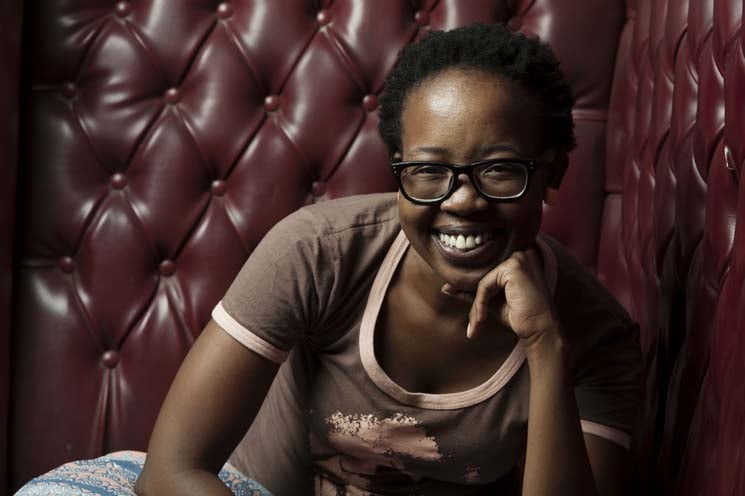
Artist and activist Ntsiki Mazwai poses for pictures following an interview with The Citizen in Newtown, 24 February 2014. Picture: Refilwe Modise
“South Africa is in a potentially dangerous position in that its freedom has exposed new money that has in turn exposed behaviours that come with suddenly having something after having come from nothing,” Mazwai explains.
“And the result is that the role of the artist has been compromised and has lost its value.
“It seems like South Africa fought for its freedom to be like the West. It does not seem like South Africa fought for its freedom to be African.
“If the priority was black conscioussness and the freedom to be black finally, I think that we would be in a different space. Then we would have a dignified nation, a nation who owned who they are.”
Some artists have publicly stated which parties they are affiliated with, but for the most part the calibre of artist or their art is not of great significance to the parties involved. Mazwai feels that artists should steer clear of such political occupations.
“I don’t think an artist should be associated with a political party,” Mazwai says.
“An artist speaks for the people, and I think that once an artist starts speaking on behalf of a political party, then they start thinking about their stomach.
“I think you should always speak for the people because you don’t represent certain policies or agenda of a particular party, but the interests of the people.
“And in the same vein, I can’t make my politics personal. But if you use your craft politically, you put yourself in a position where you can have more change. The responsibility for an artist is a responsibility to the people.”
The current political climate, which includes worries about service delivery protests and incidents like Marikana, encourages active participation in terms of creating art that speaks to these societal challenges.
“Why are we fighting so hard to look like the West and why don’t we have confidence within ourselves?” says Mazwai.
“As South Africans, we have a low collective self-esteem. Just because America, for example, is a bigger country, it does not mean that they produce better art. We need to start to be honest with ourselves and that is what art is supposed to be.”
Examples of Political Art
1) A 1942 U.S. poster

Thinking questions:
1) What message do you think the author was trying to convey or persuade the viewer to do?
2) What is the significance of Uncle Sam in this picture?
3) How would the message change if another American icon was used instead? e.g. American Bald Eagle or Statue of Liberty
Uncle Sam has always been associated with war effort after the famous "We Want You Poster" (1917) hence, reinforcing the message of war. Message changes because in the Arts, the subtle details can make a huge difference because Arts in general, unlike Science relies not on facts to convince but rather emotions. Therefore, different people may experience the same piece of Art differently hence different characters used in Art or however they are portrayed will make a difference.
2) “Peoples of the world don’t want the war to be repeated!” cited Stalin.

2) “Peoples of the world don’t want the war to be repeated!” cited Stalin.
Thinking questions:
1) What are the distinctive features of this poster?
2) How do these features help convey the message of the poster?
The American is depicted and fat presumably from the greed of capitalism. He is also dark skin and seemed to dress like an elite which could mean that the American policymakers' have an air of arrogance with them and is disjointed from their people whilst his Soviet counterpart is depicted as the common man in worker overalls and noticeably more aesthetically appealing. Emphasizes the perceived negatives about the American system compared to the Soviet system.
Key issues related to Political Uses and Impact of Arts
It is quite debatable the extent of impact of the Arts in politics. Different sides of the camp argue for each of their causes.
People who do not believe of the impacts say that the messages within the Arts cannot compare with the amount of thought and individual makes when he decides his political allegiance. Much more practical reasons like standard of living or human rights would easily a stronger basis for argument than what the Arts are portraying. In another words, the decisions made are influenced by other more pressing factors rather than what the Arts portray.
However people who argue for the impacts of the Arts say that Arts has the ability to affect us in subtle ways, it may not result in an immediate change but if exposed to it for prolonged periods, it has the ability to make us reconsider or to even change our stance on an issue. In fact, its power lies in the fact that it is discrete and highly versatile, unlike the vulgar and blatant methods like fiery speeches and mass rallies.
1) What are the distinctive features of this poster?
2) How do these features help convey the message of the poster?
The American is depicted and fat presumably from the greed of capitalism. He is also dark skin and seemed to dress like an elite which could mean that the American policymakers' have an air of arrogance with them and is disjointed from their people whilst his Soviet counterpart is depicted as the common man in worker overalls and noticeably more aesthetically appealing. Emphasizes the perceived negatives about the American system compared to the Soviet system.
Key issues related to Political Uses and Impact of Arts
It is quite debatable the extent of impact of the Arts in politics. Different sides of the camp argue for each of their causes.
People who do not believe of the impacts say that the messages within the Arts cannot compare with the amount of thought and individual makes when he decides his political allegiance. Much more practical reasons like standard of living or human rights would easily a stronger basis for argument than what the Arts are portraying. In another words, the decisions made are influenced by other more pressing factors rather than what the Arts portray.
However people who argue for the impacts of the Arts say that Arts has the ability to affect us in subtle ways, it may not result in an immediate change but if exposed to it for prolonged periods, it has the ability to make us reconsider or to even change our stance on an issue. In fact, its power lies in the fact that it is discrete and highly versatile, unlike the vulgar and blatant methods like fiery speeches and mass rallies.
Essay Question and Outline
"Arts play a diminishing role in modern society." Discuss.
Definitions and keywords:
1) Arts - the expression or application of human creative skill and imagination, typically in a visual form such as a painting or sculpture and also subjects primarily concerned with human creativity and social life
Stand: I disagree to a large extent
TS1: Arts continue to play and important role in society because it provides us with the moral direction in which mankind should follow in pursuit of advancements. " Science may tell us how to bring a dinosaur back to life but the Arts tells us why it's not a good idea". Science is like the paddle of a boat, it gets us to places but it does not tell us what direction to head to.
E.g.
Science has advanced to a level which is able clone organisms which it proved by the creation of Dolly the Sheep, the first cloned animal in history. However literary texts often tells us the adverse effects of cloning and clones, most famously the German Doppelganger which seen as a paranormal clone of a person and is said to be the harbinger of death and bad luck.
TS2: The creative thought processes that pervade the Arts are essential in providing inspiration for our daily lives and the advancement of science and technology. It trains our minds to think outside of the box and lead us to new discoveries.
E.g.
We often look to science fiction/fiction books for inspiration on the next big invention. Jules Verne's Twenty Thousand Leagues Under the Sea and George Lucas's Star Wars Franchise are notable examples of how elements of science fiction can induce scientists to attempt to create similar contraptions. In the case of the Nautilus, it manifested itself into the modern day submarine.
TS3: The Arts are great tools to mobilise and rally people. The Arts is able to convey messages on an emotional level that may appeal to more people.
E.g.
Look no further than the cult of Harry Potter, the power of the creativity of the mind and the English Literature is plain for all the see. Needs no explanation
Propaganda posters and movies used throughout the world. Governments often use short films by filmmakers like Royston Tan to direct thought provoking and heart wrenching short films to convey message.
Counter Point 1: The role of technology has greatly diminished the entertainment value of the Arts and has replaced the Arts as the main form of entertainment in modern society.
E.g
Youths spend and increasingly large amount of time online. Games like Halo and Grand Theft Auto are able to make billions of dollars within a few weeks but new plays or new books are unable to match such a monstrous demand
Monday, 3 March 2014
Social and non-motivated uses of arts
Social Uses and Impacts of Arts
Arts can be used to improve
social cohesion and raise awareness on social issues as arts of all form have
the ability to capture attention and move people.
1. Art improves social cohesion
Art events bring people
together, allowing friendships to be forged. Some art events promote
understanding among cultures and within communities, enhancing neighbourhood
security. Art also helps in rehabilitation.[1]
Therefore, there is increased
effort by various countries for example UK, Ireland and Netherlands in
improving the arts scene for social stability.
· Ireland
http://www.creativecity.ca/database/files/library/NESF_report.pdf
· Netherlands
http://www.cjc-online.ca/index.php/journal/article/view/1300/1331
2. Trashion
Trashion has been around even
before the term was coined. Indigenous people throughout the world have used
salvaged materials to create new objects since a long time ago. However, using Trashion to raise awareness
on social issues like environmental protection and even poverty is said to
be started in the 1990s by Ann Wizer who created costumes made entirely from
post consumer plastic to celebrate Earth Day.
Trashion is now prevalent all
over the world.
· An instance of Trashion on Febuary
2014 to promote recycling http://www.moabtimes.com/view/full_story/24489323/article--Trashion-fashion--takes-center-stage-Feb--1
· A company that uses Trashion to
alleviate poverty
http://www.monsoonvt.com/about_monsoon_vermont.cfm
As quoted by Nancy Judd, an
artisit and environmental educator, Trashion is a good way to champion the
cause of environmental protection without being “gloom-and-doom”. She also “likes
the idea of making aluminum elegant or rusty nails sexy.”

3.
Use of arts to stop street harassment
· Examples
http://www.stopstreetharassment.org/toolkits/art/
· “Stop Telling Women to Smile”
Initiative
http://mongoosmagazine.com/catartists/stop-telling-women-smile-street-art-talks-back-harassment/
Thinking Question
è
How does the social use of art
differ in less developed and developed countries?
Uses and Impacts of
Non-Motivated Functions of Arts
Art is also a basic
human instinct for harmony, balance and rhythm. For some, art is ritualistic, cultural and symbolic, while others see it as an expression of the imagination
and can be done for self relief.
1. Fine Art
Fine art is
art that is produced primarily for beauty rather than utility. Fine art often
stems from pure creativity and self-expression and exists for the sake of
existing.[2] Fine art can be
created anytime, anywhere and by anyone.
2. Art as a cultural identity/norm
Art is a kind of thinking or
making which enables people to form and develop their identity. (Excluding the use of arts for promotion of religious purposes. This point is more on the origins and arts as part of a lifestyle.)
· Arts of the Suriname Maroons
http://www.folklife.si.edu/resources/maroon/educational_guide/28.htm
· Aboriginal Australian Art
http://australia.gov.au/about-australia/australian-story/austn-indigenous-art
· Arts in Chinese Culture
http://www.randomhistory.com/1-50/025chinese.html
http://www.randomhistory.com/1-50/025chinese.html
Thinking Question
è
Have cultural groups succumbed to
the lure of monetary gains and sacrificed the true meaning of their art?
Subscribe to:
Posts (Atom)